Monumento a la Patria: Mexico’s history carved into Mérida
- Local name
- Monumento a la Patria
- Type
- Twentieth-century commemorative sculpture and civic monument
- Continent
- North America
- Country
- Mexico
- Region
- Yucatán
- Regional subdivision
- Mérida municipality
- Historical record
- Construction began 1945; completed 1956
- Date
- March 2025
- Photographer
- Bruno Sellés
- Published
- August 6, 2025
- Reviewed
- November 7, 2026
- Coordinates
- 20.9897, -89.6168
- More
- Wikipedia
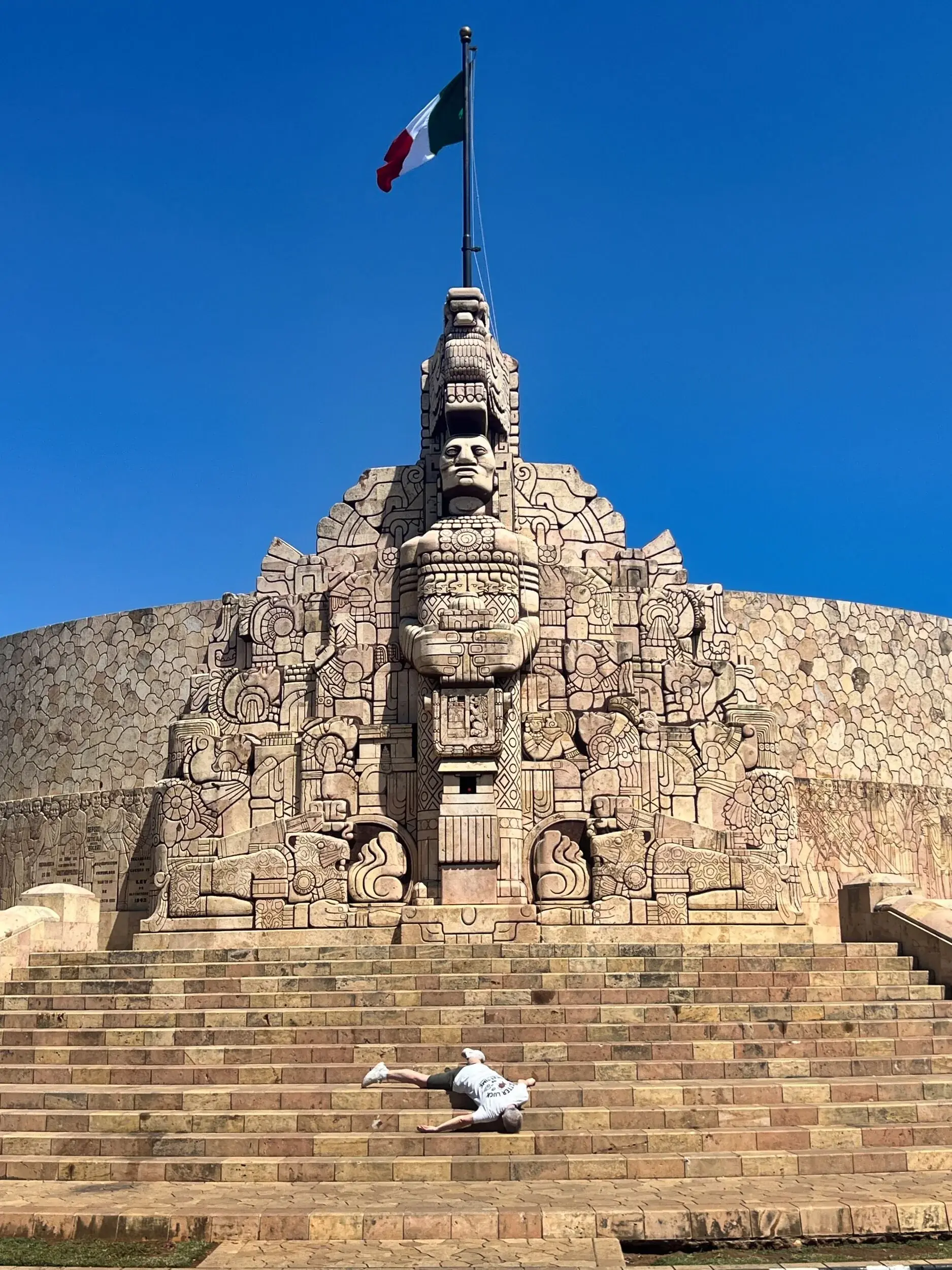
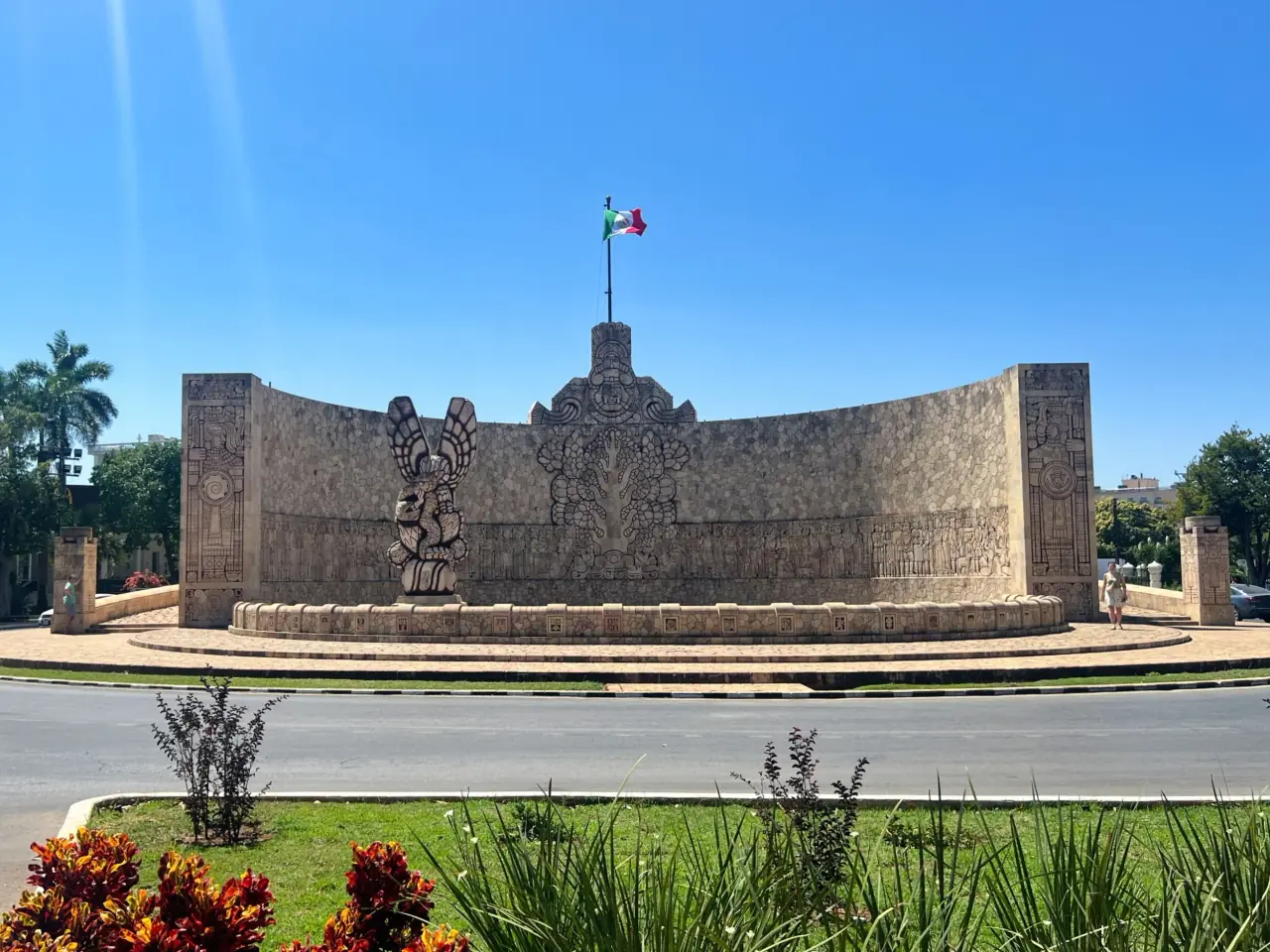
A curved stone wall, a monumental female figure and an eagle with a serpent make the Monumento a la Patria more than a pedestal for a single hero. On Mérida’s Paseo de Montejo, history becomes a surface that can be read from several directions. The monument brings national events into a visual language shaped by Yucatán and by the twentieth-century reinterpretation of Indigenous imagery.
Its sculptor was Rómulo Rozo, a Colombian-born artist who worked extensively in Mexico. The municipal account dates the beginning of construction to 1945, with completion in 1956. This was a long project involving architectural and building expertise alongside sculpture, rather than a commission that suddenly appeared in the early 1950s. S1S2
A national narrative on a Yucatecan avenue
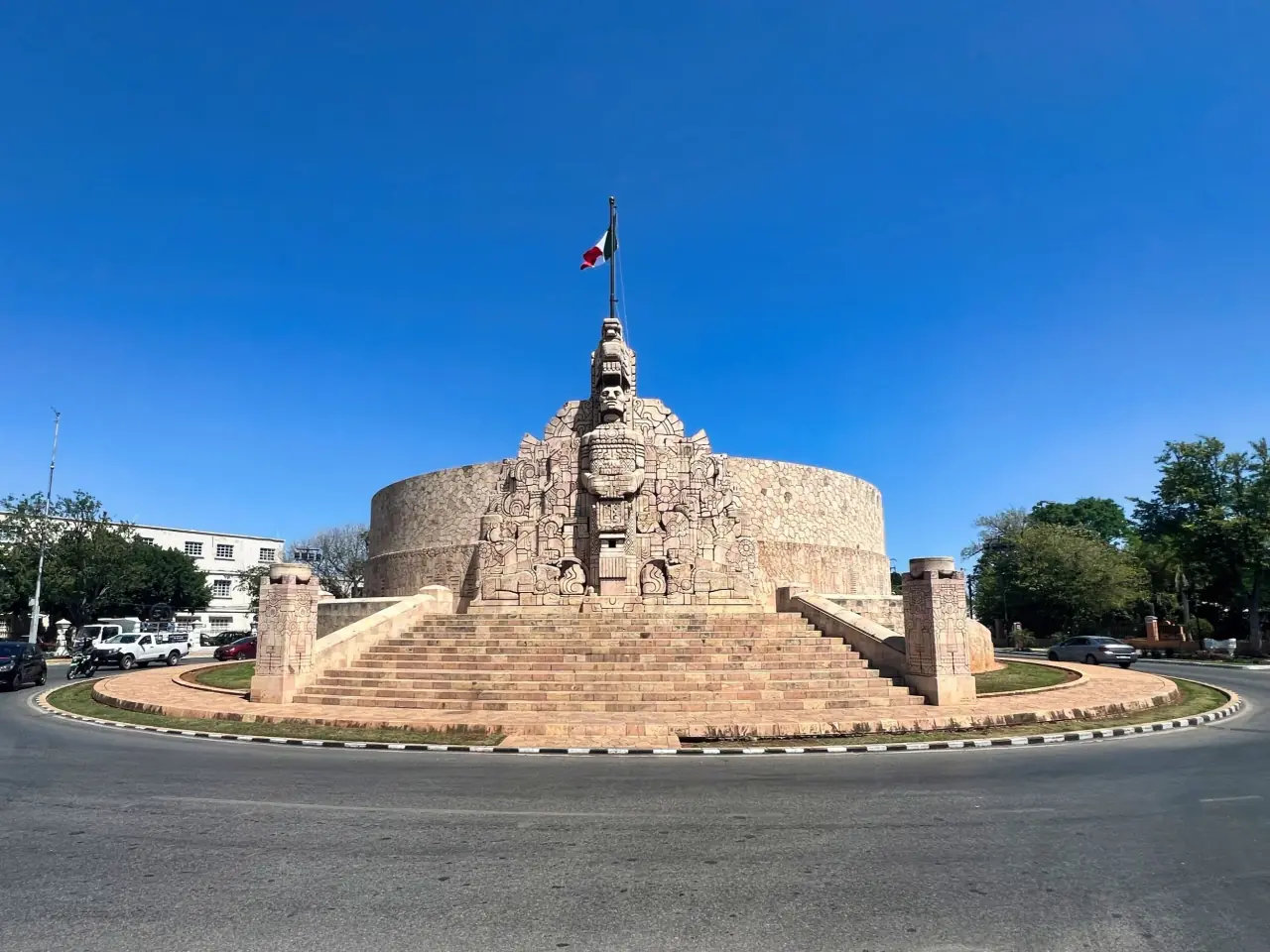
Paseo de Montejo provides an urban setting in which a monument is seen repeatedly: from approaching streets, through moving traffic and from its steps. The broad staircase raises the principal image above the road. The long curved wall then extends the reading sideways, so that the central figure and the reliefs operate at different scales.
This arrangement is important to the subject. A national history contains many episodes, but a public monument needs a recognisable overall form. Rozo’s work offers both: an emblem visible at a distance and a dense sequence of figures that requires close attention. The visitor moves between the whole and the detail rather than taking in every scene from one fixed point.
Rozo and the making of a modern monument
A study published by the Instituto de Investigaciones Dr. José María Luis Mora places Rozo’s Mexican work within the movement of artists, ideas and cultural relationships between Colombia and Mexico. It also identifies the involvement of Manuel and Max Amábilis and master builder Víctor Nazario Ojeda in the Mérida project. The attribution to Rozo describes the sculptural authorship without erasing the work’s collaborative construction. S2
The monument belongs to the twentieth century, even where it draws on pre-Hispanic forms. This distinction prevents a common misunderstanding: a Maya-inspired motif does not make the wall an ancient Maya building. Its imagery was selected and recomposed for a modern public account of Mexico.
The expression Neo-Maya is useful in that specific sense. It points to a later architectural and artistic engagement with Maya references. It does not imply that every element reproduces one archaeological prototype or that Mexico’s many Indigenous cultures were interchangeable.
The central woman: the nation given a body
The principal female figure personifies the homeland. The municipal and scholarly descriptions connect her clothing and symbolic attributes with regional identity and Maya references. The composition turns an abstract political idea into a body that can preside over the entire wall. S1S2
Reading her as an allegory is different from identifying a portrait. Her role is not to represent a single named woman whose biography explains the monument. She gathers meanings into one figure, allowing Yucatecan imagery to participate in a national story.
Above and around that centre, the architecture creates a strong vertical emphasis. Steps, figure and flagpole draw the eye upwards; the broad wings of the monument distribute the historical episodes horizontally. Those two directions organise the experience before any individual inscription is deciphered.
How the reliefs tell history
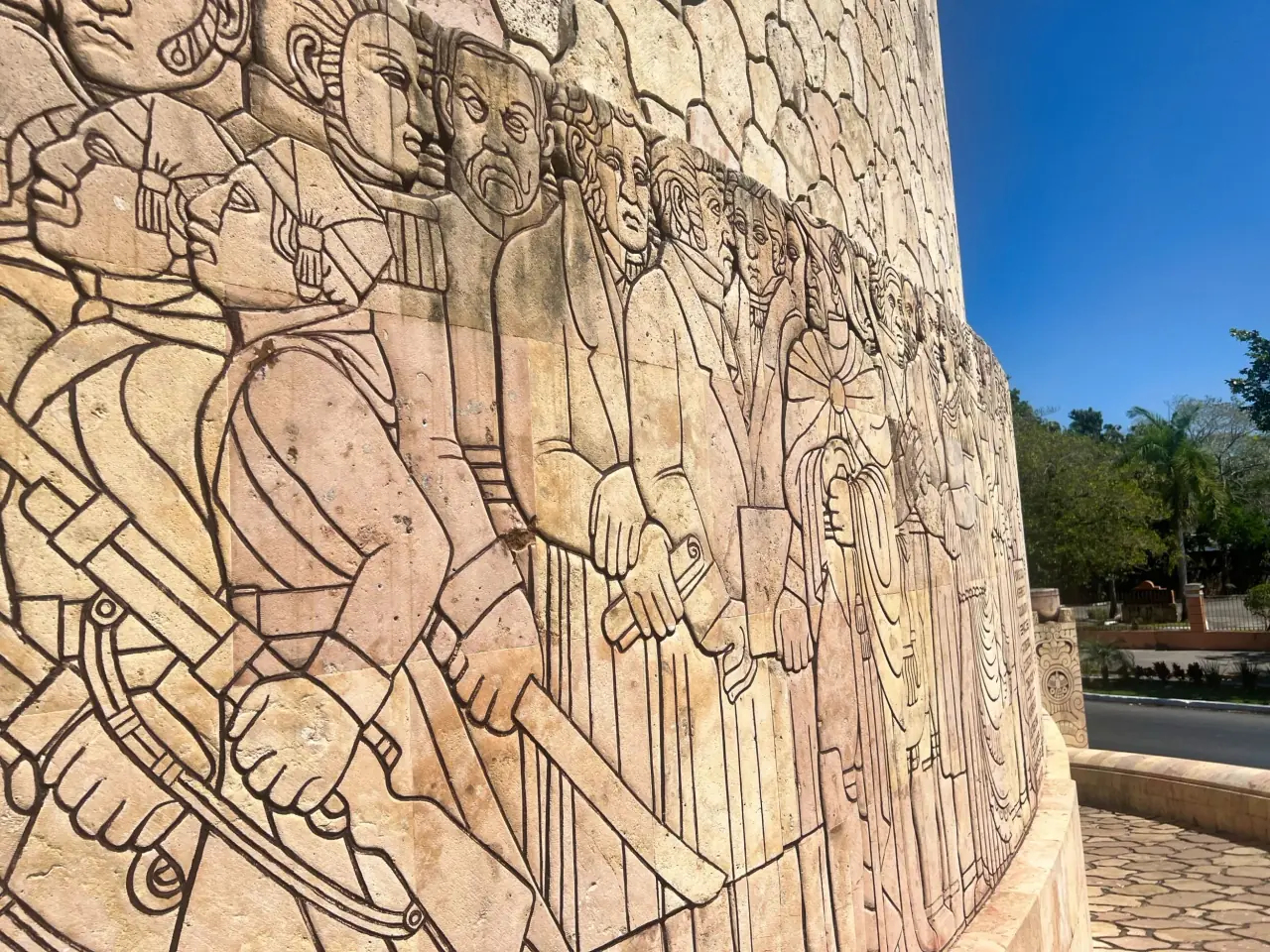
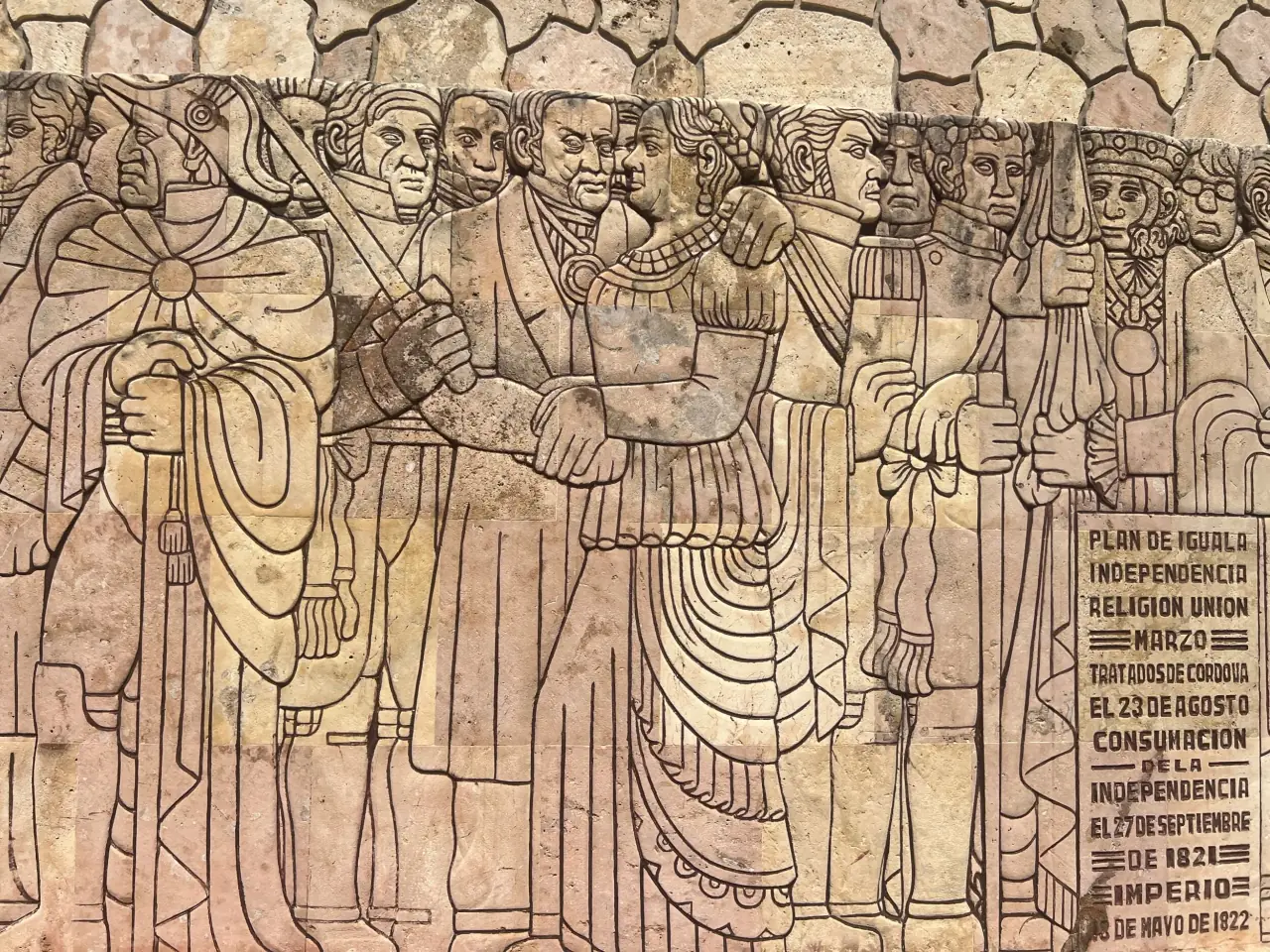
Figures are compressed into sequences; clothing, headgear, weapons and inscriptions help distinguish episodes. Changes in depth and the direction of daylight give the stone its graphic force.
One inscription refers to the Plan of Iguala and events surrounding independence and the early empire. Rather than guessing the identity of every face, the safest way to begin is with what the wall actually supplies: readable names, dates and written references. Those clues locate an episode within the larger narrative.
The adjacent view shows how figures occupy a curved surface. A relief is not simply an illustration pasted onto a flat page. The viewing angle alters the overlap of bodies and the shadows within carved lines. Walking changes what can be seen clearly and how a procession of figures is grouped.
History and the selection of history
The wall offers a commemorative interpretation, not an exhaustive textbook. Turning centuries into a continuous public image requires choosing protagonists, conflicts and symbols. The result tells us about the events represented and about the mid-twentieth-century ambition to make national identity visible in civic space.
This does not make the monument historically worthless. It makes a second question necessary: why were these episodes arranged together here? A source of knowledge should help readers notice that selection instead of repeating an unqualified claim that the monument contains the whole history of Mexico.
The other side: eagle, serpent and water
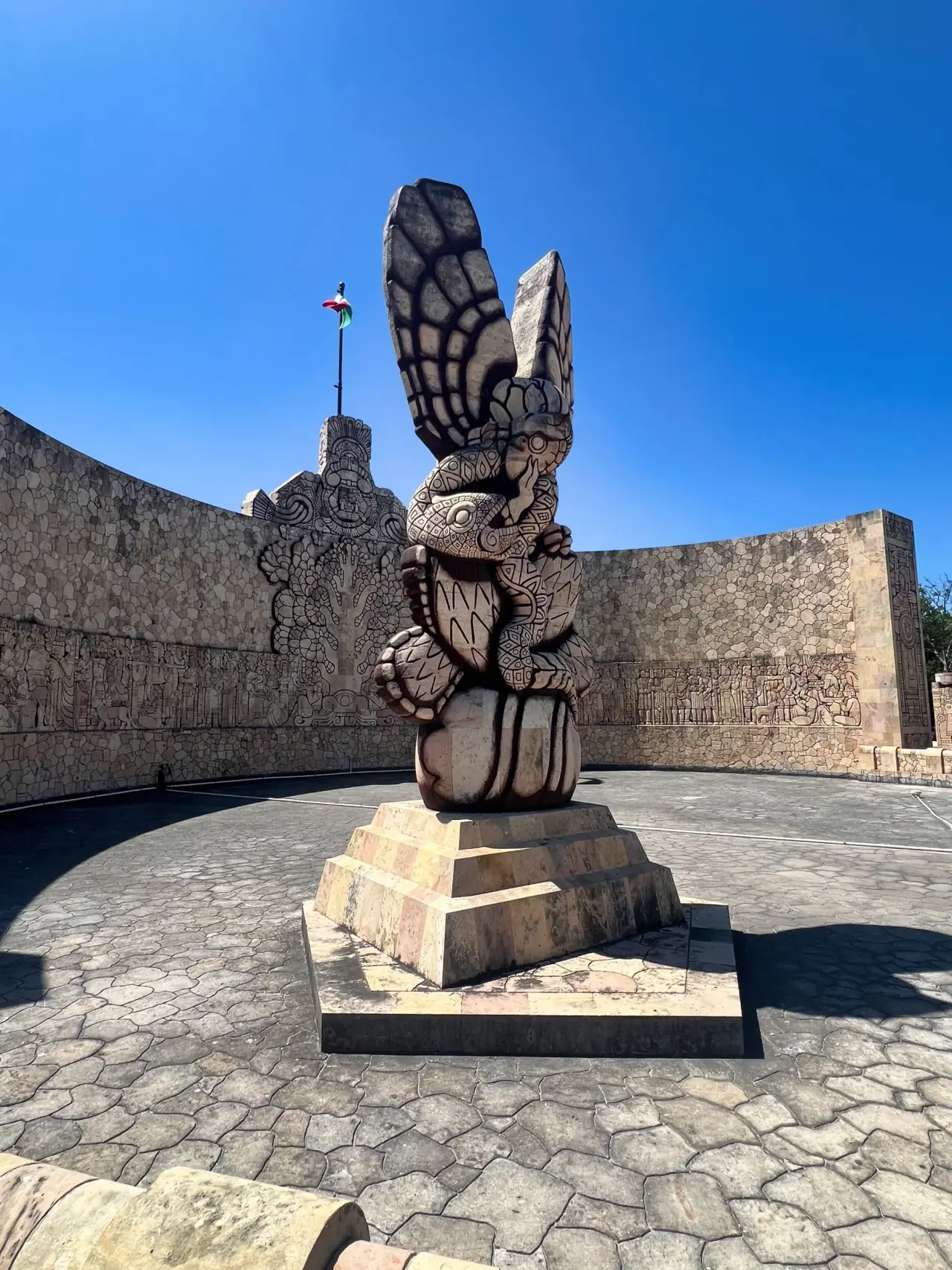
The back of the monument is a second composition. The wall embraces an interior space, with a sculpted eagle-and-serpent group standing forward from it. The municipal account relates the image to the national emblem, the founding of Tenochtitlan and Lake Texcoco. S1
The eagle stands on a nopal cactus while holding the serpent. This is a reference associated with Mexica tradition and the Mexican coat of arms. It should not be labelled generically as a Maya bird simply because the monument also contains Maya-inspired imagery. The combination of traditions is part of the modern national programme.
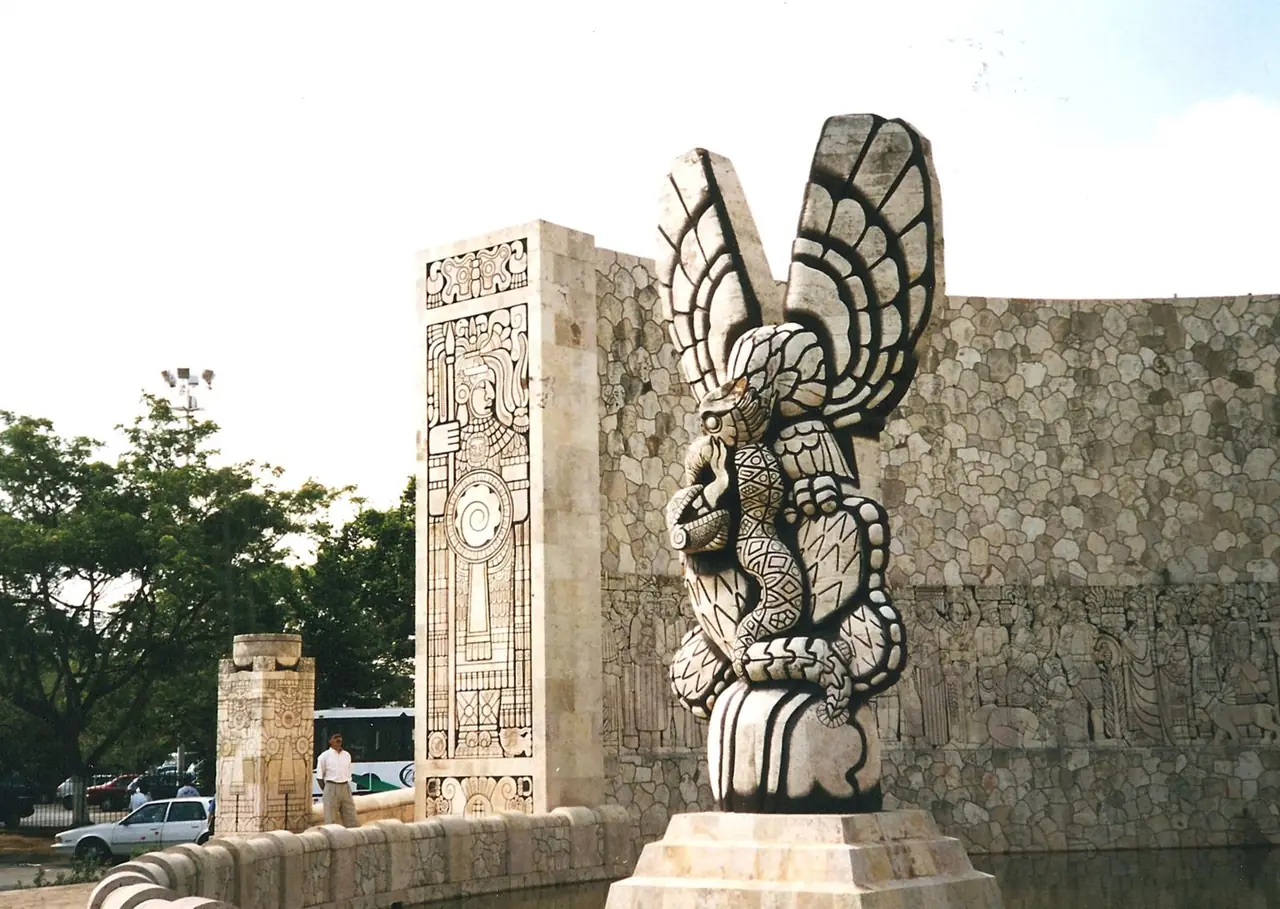

The relation between a projecting emblem and a narrative wall differs from the frontal relationship between the female figure and the staircase.
Stone, light and the work of looking
The reliefs depend on contrast. In broad light, the surface can look almost like a continuous drawing; stronger side light gives figures greater volume.
That visible workmanship matters more than an unsupported numerical total of figures. Counts can depend on whether heads, emblems and secondary motifs are treated as separate subjects.
Questions about the Monumento a la Patria
Who made it?
The sculptural author is Rómulo Rozo. The project also involved Manuel and Max Amábilis and Víctor Nazario Ojeda.
Is it an ancient Maya monument?
No. It is a twentieth-century monument, constructed from 1945 and completed in 1956, incorporating pre-Hispanic references into a modern national programme.
What does the eagle represent?
The eagle, serpent and nopal relate to Mexico’s national emblem and the foundation tradition of Tenochtitlan.
Is it UNESCO World Heritage?
No. It has no independent World Heritage inscription.
Sources and further reading
More in Mexico
 UNESCO WH