Ruins of Saint Paul's: The Facade That Survived the Fire
- Local name
- 大三巴牌坊 · Ruínas de São Paulo
- Type
- Church ruins
- Continent
- Asia
- Country
- China
- City
- Macau
- Location
- Santo António, next to the Mount Fortress
- Built
- 1602–1640
- Destroyed
- 26 January 1835
- Facade
- Carved 1620–1627; about 26 m high
- Restoration
- 1990–1995; museum opened 1996
- UNESCO
- Historic Centre of Macao (2005) · My World Heritage list
- Date
- April 2009
- Photographer
- Merche Mateo
- Published
- October 23, 2021
- Reviewed
- November 15, 2026
- Coordinates
- 22.1977, 113.5409
- More
- Wikipedia
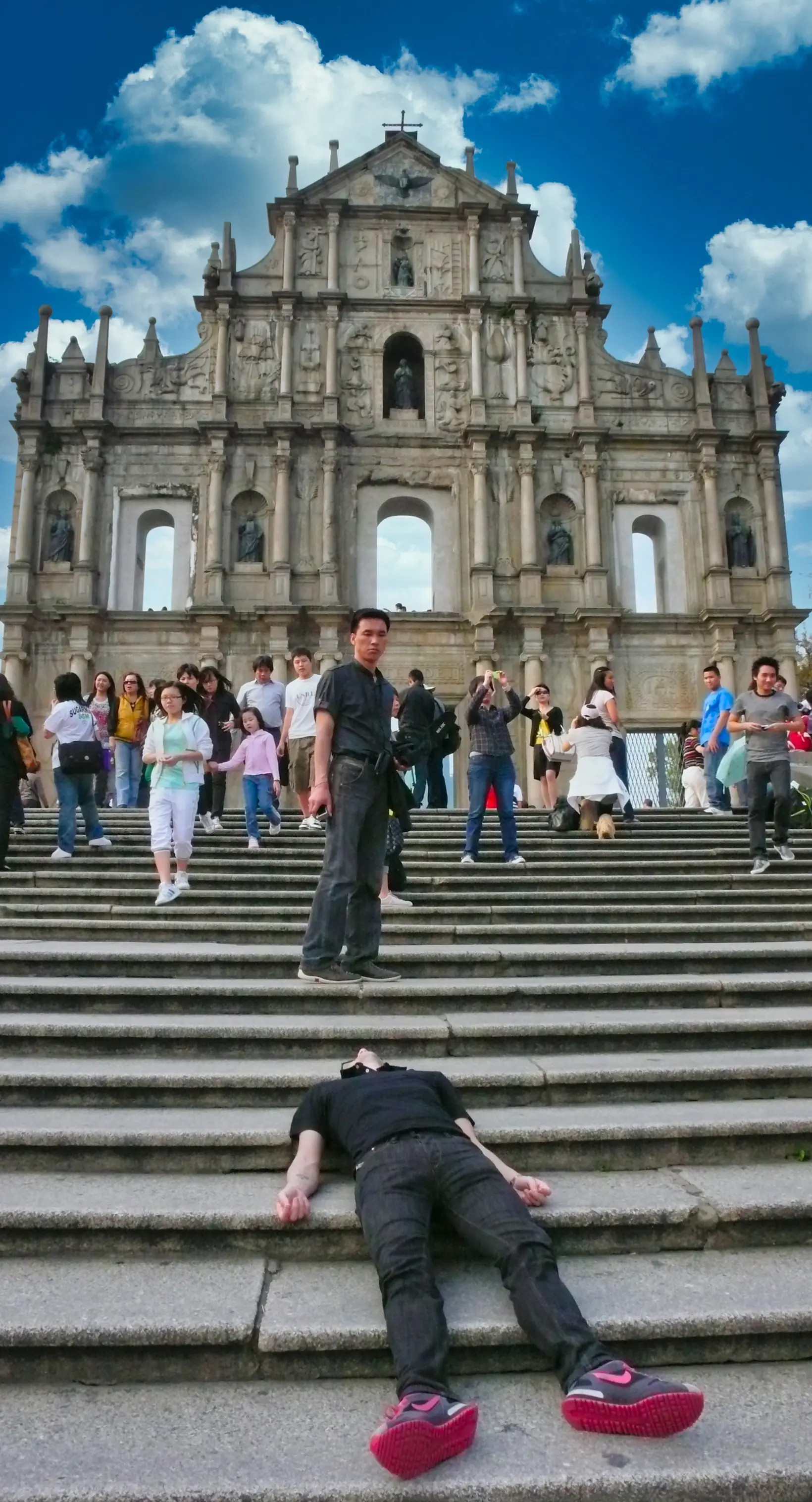
The Ruins of Saint Paul’s are the remains of a seventeenth-century Catholic religious complex in Santo António, Macau S1. In Chinese they are called Dai Sam Ba Paifang, and in Portuguese Ruínas de São Paulo S1. The Chinese name refers to the shape of the facade, which resembles a traditional memorial archway.
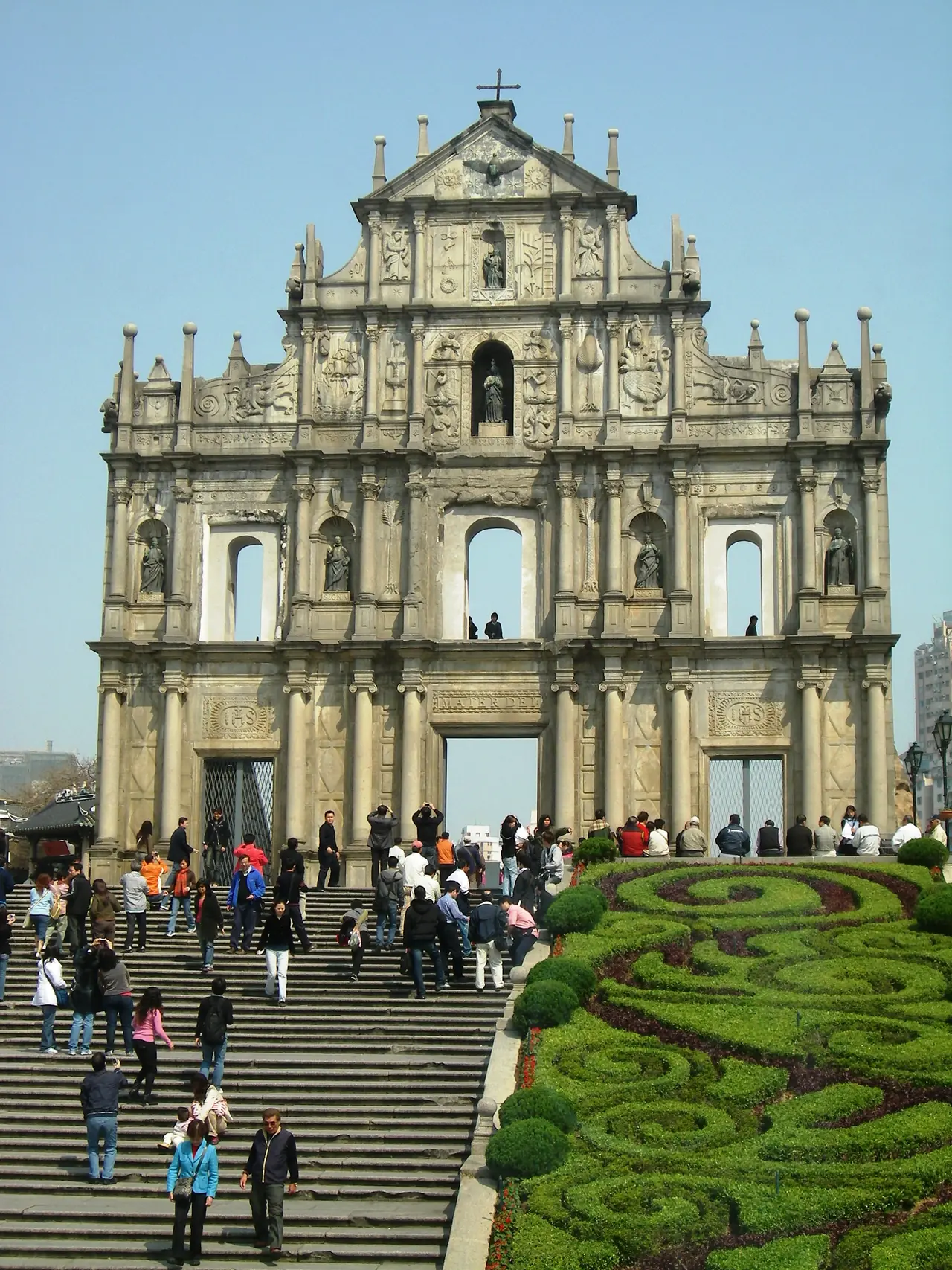
They include what was once St. Paul’s College and the Church of St. Paul, also known as Mater Dei, dedicated to Saint Paul the Apostle S1. Today the ruins are the best-known landmark of Macau S4. Thousands of visitors climb the steps to see the facade every day.
A Jesuit complex in Macau
The Jesuits were among the first Europeans to settle in Macau. Their college, founded in 1594, functioned as a university at the service of the Portuguese S11. It was one of the first Western-style universities in East Asia.
A first church was built on the site in 1580 S8. After suffering fire damage, it was rebuilt, and the present church was constructed between 1602 and 1640 S6 S12. Construction took almost four decades.
The foundation stone, laid in 1602, lies under the front wall S2. An inscription on the facade can be read as a dedication by the city of Macau to the Great Virgin Mother in that year S13. The text shows how closely the church was tied to the life of the city.
At the time it was the largest church in Asia, and it was acclaimed as the Vatican of the Far East S4. The church stood on top of a hill, overlooked by the Mount Fortress S1. Its size reflected the wealth of Macau as a trading port between Europe, China and Japan.

Builders from three continents
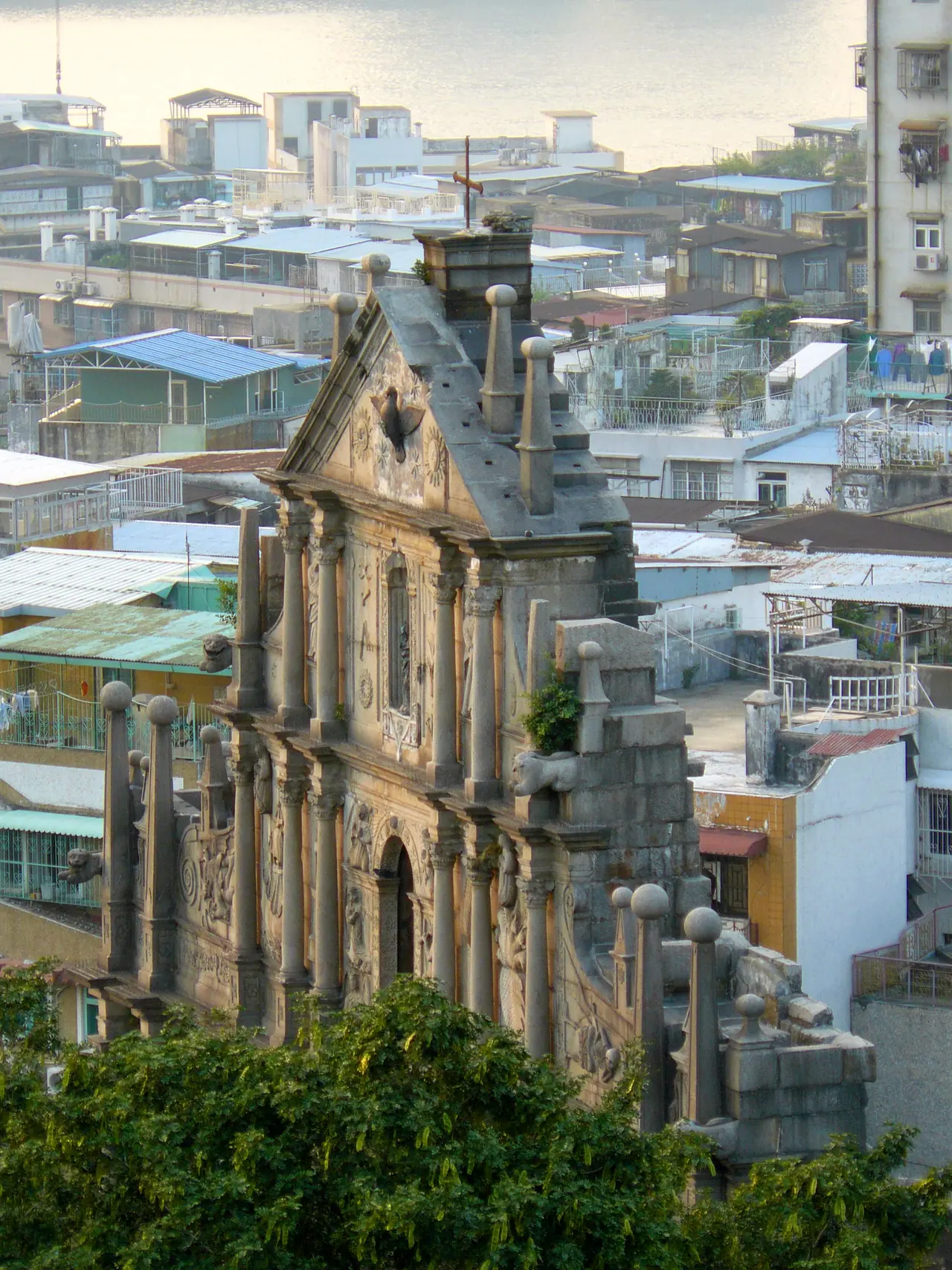
The facade was intricately carved between 1620 and 1627 by Japanese Christians in exile and local craftsmen, under the direction of the Italian Jesuit Carlo Spinola S1. Many of the Japanese builders had fled persecution in Nagasaki S10. Their skill can still be seen in the delicacy of the stonework.
The result is a meeting of styles and cultures. The ruins are considered one of the finest examples of Macau’s character as a city of exchange between Europe, China and the rest of Asia S6. Christian, European, Chinese and Japanese influences appear side by side.
The building was a Baroque church in stone and wood, with a granite facade and a wooden structure behind it S4 S1. The college next door was a centre of learning for missionaries heading to China and Japan S11. Its library and teachers made it one of the intellectual centres of the region.
For more than a century, the Jesuits trained there the priests who would preach across East Asia. The church was the centre of Catholic life in Macau. Its bells could be heard across the old city.

A facade full of symbols
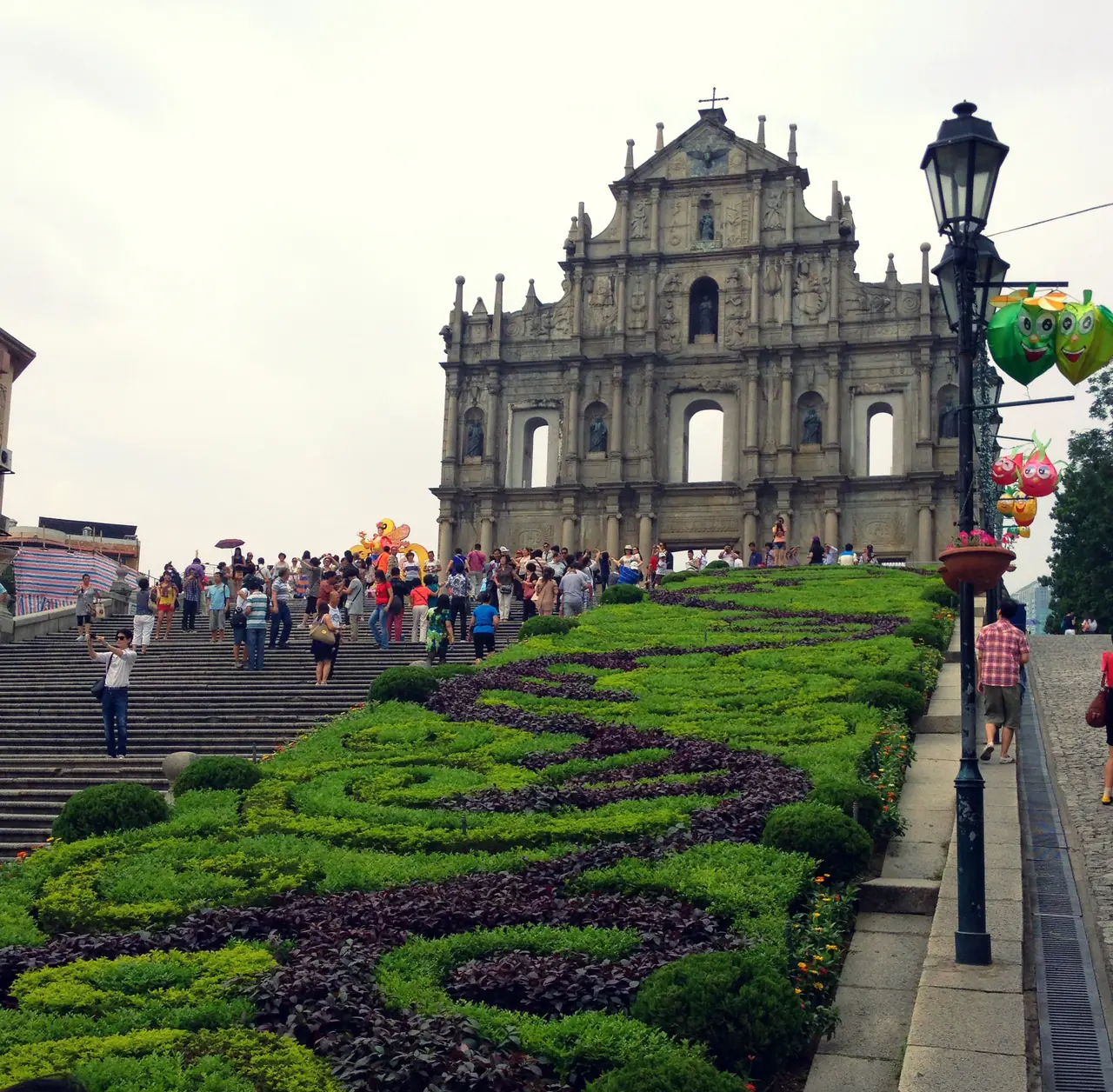
The facade rises in five tiers, decorated with statues, carvings and inscriptions S4 S5. On the lowest level, the central door bears the words MATER DEI, Mother of God, flanked by the IHS emblem of the Jesuits S5 S2. The proportions follow the models of Jesuit churches in Europe.
Above stand bronze statues of Jesuit saints, including Saint Ignatius of Loyola and Saint Francis Xavier S5 S3. At the very top, a dove with outstretched wings represents the Holy Spirit S4. Each level of the facade tells part of a story of faith and salvation.
The carvings combine Christian imagery with Asian motifs. One famous panel shows the Virgin Mary stepping on a seven-headed hydra, described in Chinese characters as the Holy Mother trampling the heads of the dragon S1.
Other details include a Chinese dragon and a Japanese chrysanthemum S7. Few European church facades tell so clearly the story of the people who built them. Visitors can spend a long time discovering new details.

The fire of 1835
In the eighteenth century the Jesuits were expelled from Macau, and the church was used as an army barracks S3. The complex had already suffered fires in the seventeenth century S5. Without the Jesuits, the buildings slowly lost their original purpose.
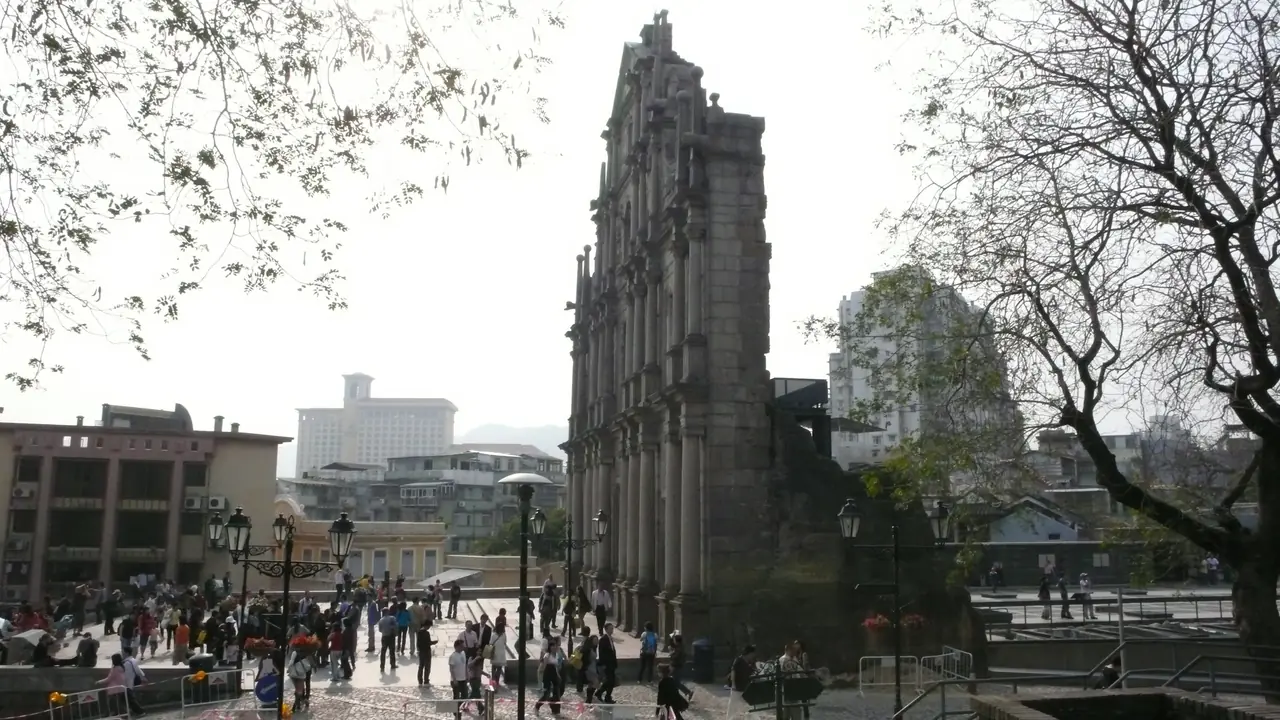
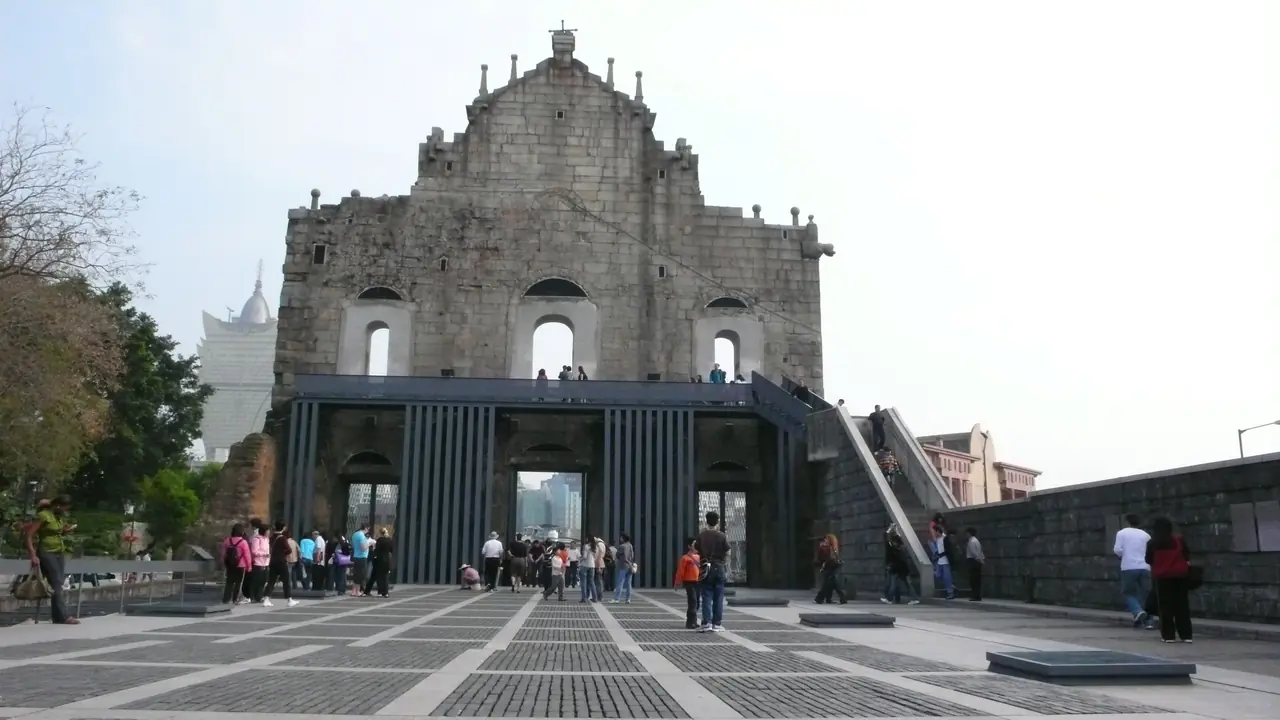
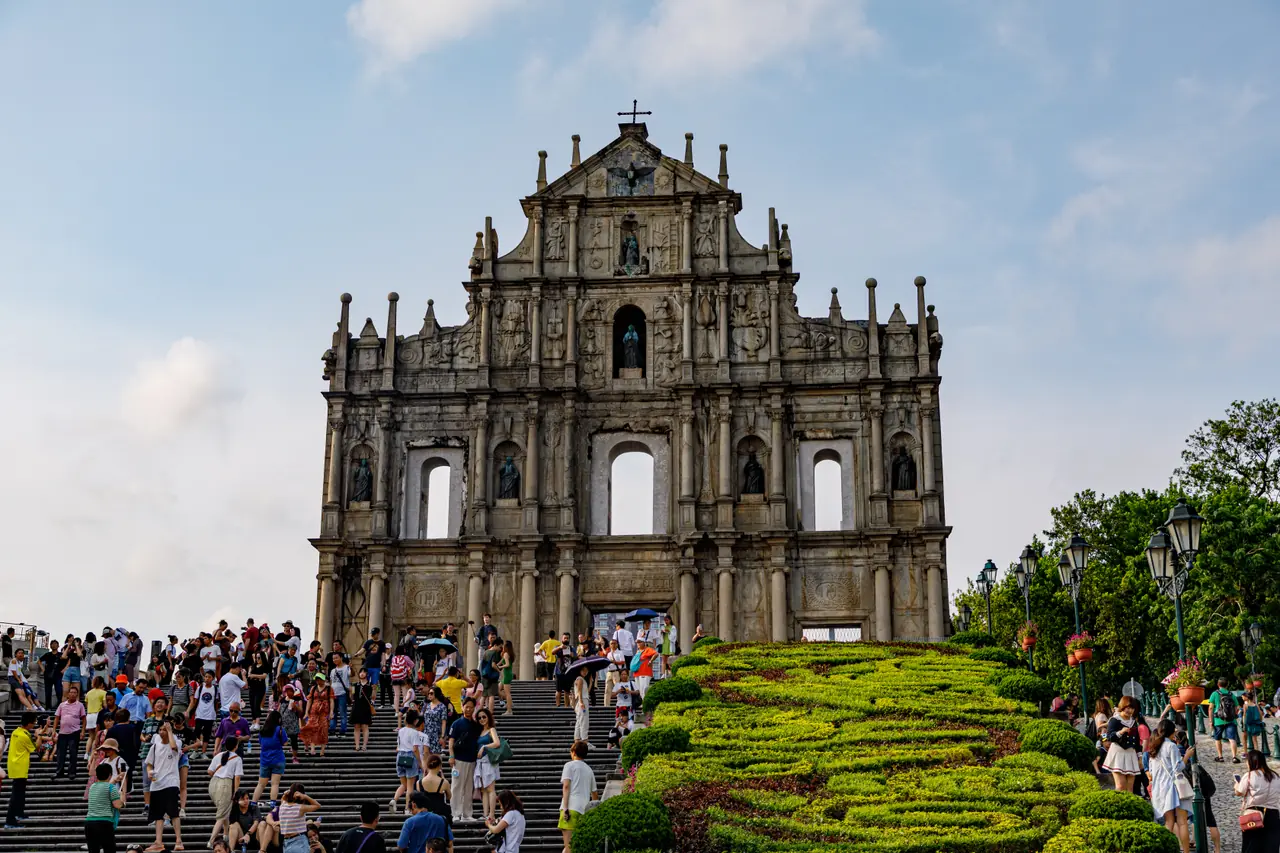
On 26 January 1835, during a typhoon, a fire destroyed the college and the church S1. Only the granite facade and the grand staircase survived S4. The wooden roof and interior burned completely.
The church had burned for the third time in its history S8. A drawing of the facade by Wilhelm Heine from 1854 and a photograph by John Thomson from 1870 show the ruins as they stood in the nineteenth century S2. These images are valuable records of the site before modern restoration.

Restoration and the crypt
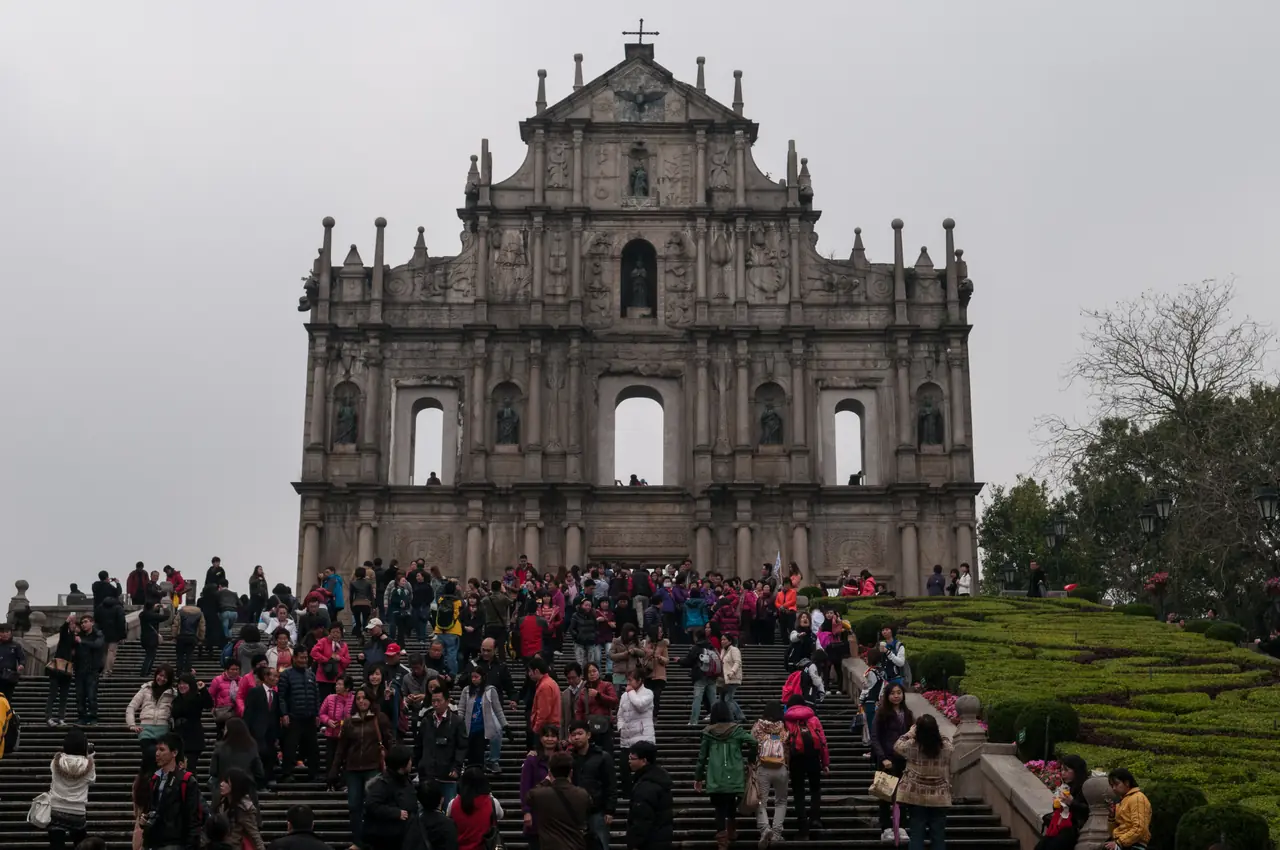
The facade has stood alone ever since, like the front page of a book whose pages have burned. It became the symbol of Macau. Painters and photographers have portrayed it for almost two centuries.
The ruins were restored between 1990 and 1995 S8. The facade was reinforced with steel to prevent its collapse S7. A metal staircase behind the facade now allows visitors to look through its upper windows.
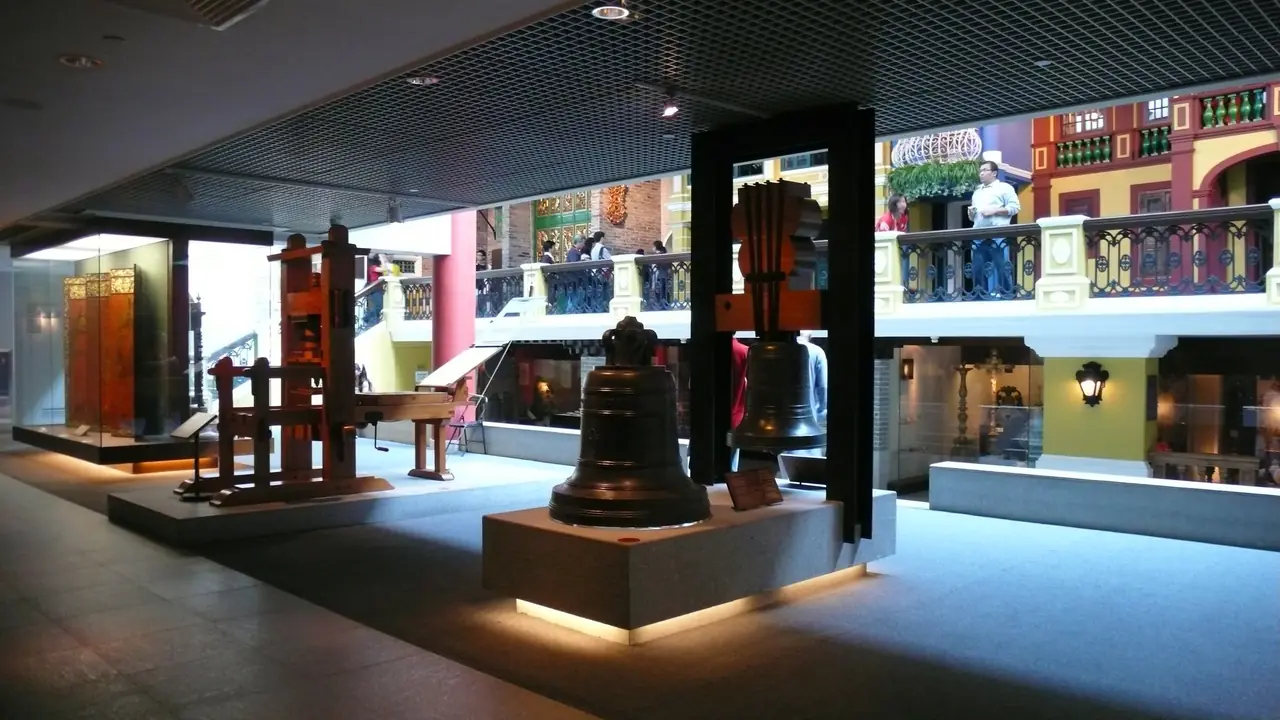
Behind the facade, the Museum of Sacred Art and Crypt opened in 1996 S7. It displays religious works produced in Macau from the seventeenth to the twentieth centuries S10. Its collection includes paintings, sculptures and liturgical objects.
The crypt holds the bones of Japanese and Vietnamese martyrs S3. The museum also keeps a seventeenth-century painting of Saint Michael the Archangel, the only work to survive from the college S9. The remains of the church’s foundations can also be seen around the crypt.

Visiting the ruins
In 2005 the ruins were inscribed as part of the Historic Centre of Macao, a UNESCO World Heritage Site S4 S6. They are also one of the Seven Wonders of Portuguese Origin in the World S1. The Historic Centre includes more than twenty monuments and squares.
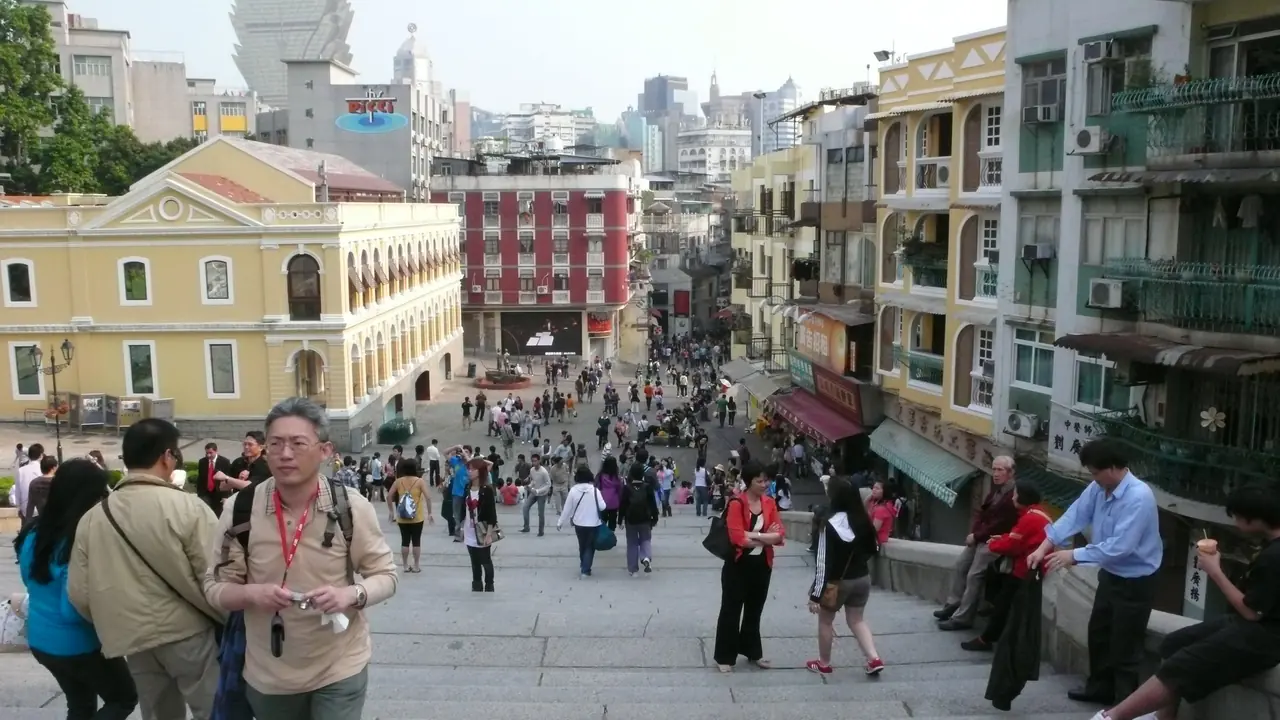
The facade stands on a small hill, reached by 68 stone steps S1. It is a tradition to throw coins into the top window from the stairs, for luck S4. The site can be very crowded in the afternoon and at weekends, so early morning is the best time to visit.
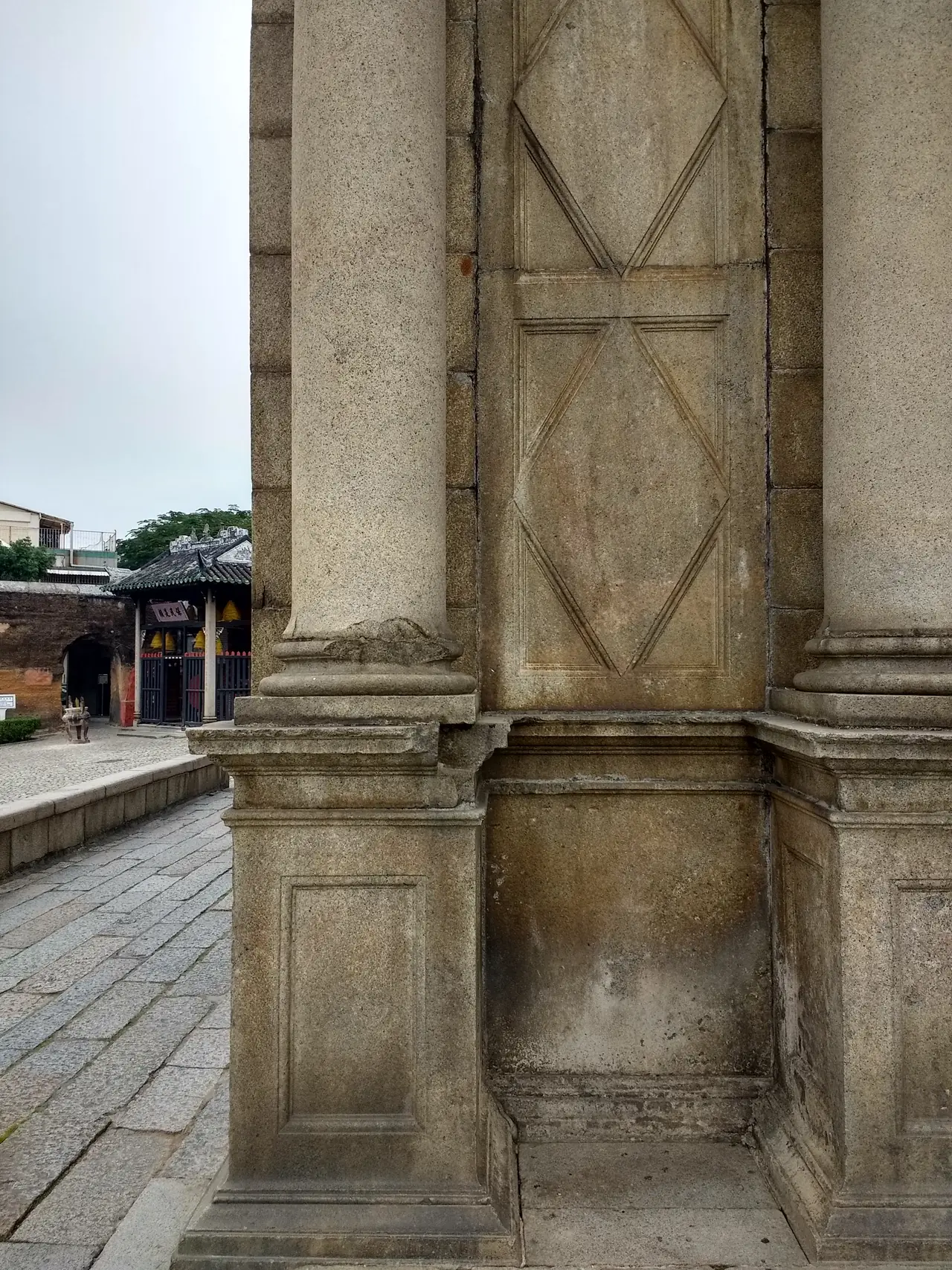
Visiting the ruins and the museum is free S1. Nearby are the Mount Fortress, the Macau Museum and the small Na Tcha Temple, which peeks out from behind the facade and shows the city’s mix of cultures. Few places sum up Macau’s history so well in a single view.

Frequently asked questions
When was the Church of Saint Paul built?
The present church was built between 1602 and 1640 S6.
Who carved the facade?
Japanese Christians in exile and local craftsmen, directed by the Jesuit Carlo Spinola, between 1620 and 1627 S1.
How was the church destroyed?
A fire during a typhoon on 26 January 1835 destroyed the church and college S1.
What is behind the facade?
The Museum of Sacred Art and Crypt, opened in 1996 S7.
Sources
- S1 Wikipedia: Ruins of Saint Paul’s.
- S2 Wikipedia: Ruins of St. Paul (gallery).
- S3 History Hit: Ruinas de São Paulo.
- S4 Culture Trip: A brief history of the Ruins of St. Paul’s.
- S5 Trip.com: Reading Macau at the Ruins of St. Paul’s.
- S6 Macao SAR Government Portal: Ruins of St. Paul’s.
- S7 ISCTE: Ruins of Saint Paul, construction study.
- S8 Travel China Guide: Ruins of St. Paul’s and Monte Fort.
- S9 Smithsonian Magazine: Macao World Heritage landmarks.
- S10 Frommer’s: Ruins of St. Paul’s Church.
- S11 Wikipedia: St. Paul’s College, Macau.
- S12 Macao Government Information Bureau: The sacred SAR.
- S13 Wikimedia Commons: Cathedral of Saint Paul in Macau.
More in China