Mind the gap: three words that changed the platform
- Country
- United Kingdom
- Local name
- Mind the gap
- Type
- Transport safety warning
- Continent
- Europe
- Region
- England
- City
- London
- Location
- London Underground stations and trains
- Historic dates
- First recorded announcement, 1968
- Physical features
- Audible warning; platform lettering; variable horizontal and vertical gap
- Materials
- Ceramic tiles, paint and audio
- Cultural significance
- Safety phrase and London transport icon
- Present use
- In active use; site-specific gap management
- Related site
- Curved and straight Tube platforms
- Date
- June 2024
- Photographer
- Fardoe Ruitenberg
- Published
- June 16, 2024
- Reviewed
- November 13, 2026
- Coordinates
- 51.5307, -0.1234
- More
- Wikipedia
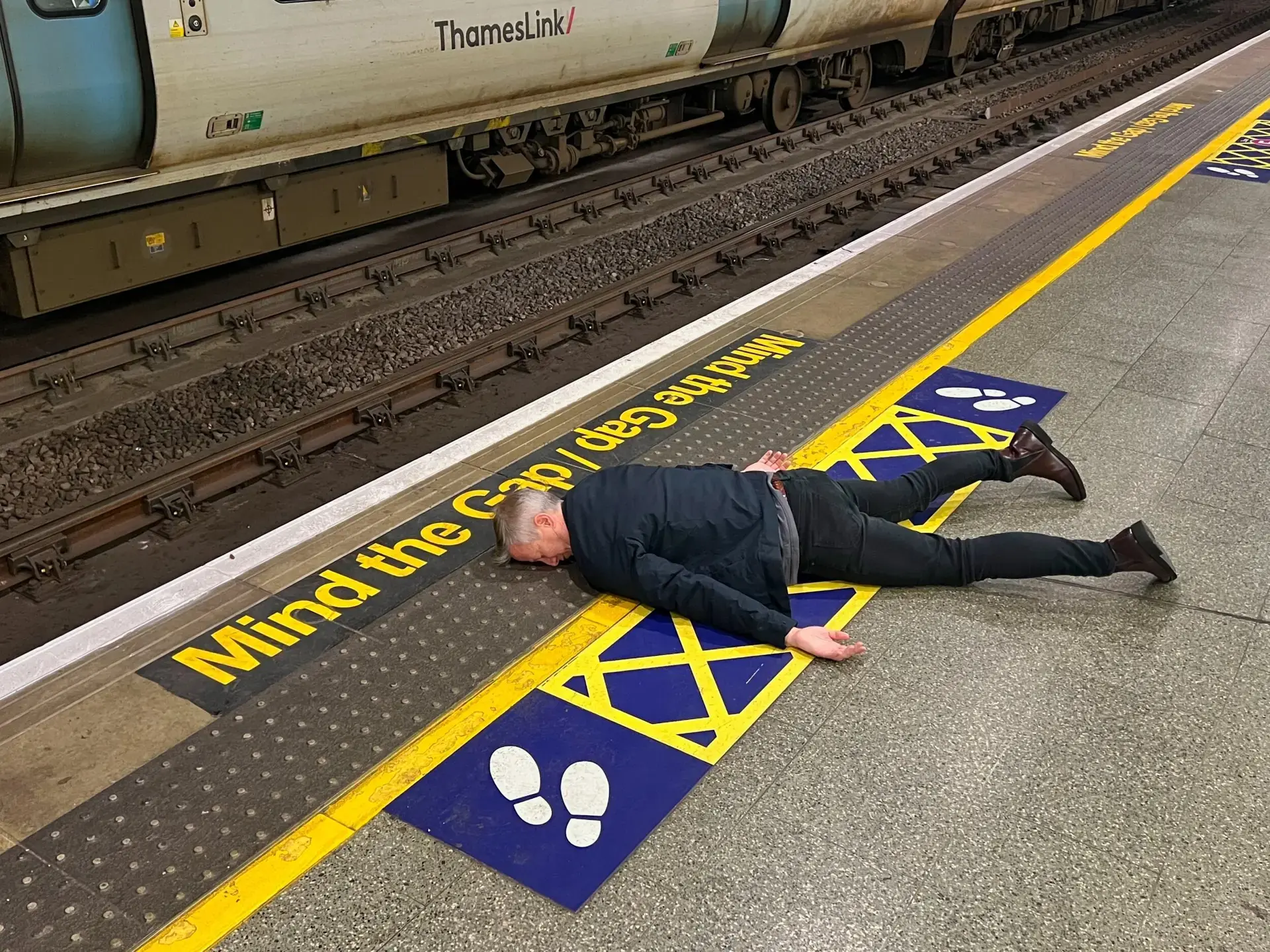
At King’s Cross, the warning is almost too familiar to notice. Yellow letters sit beside the platform edge, a train arrives, doors open, and a recorded voice asks everyone to mind the gap. The phrase has become part of London’s soundtrack, but its job is stubbornly practical. It points to the space and sometimes the step between a train and the platform. That narrow interval can be a genuine barrier, especially where a platform curves away from a straight carriage. A small sentence has to compete with announcements, movement and the urgency of boarding. S1 S3
Video
The dangerous space between two systems
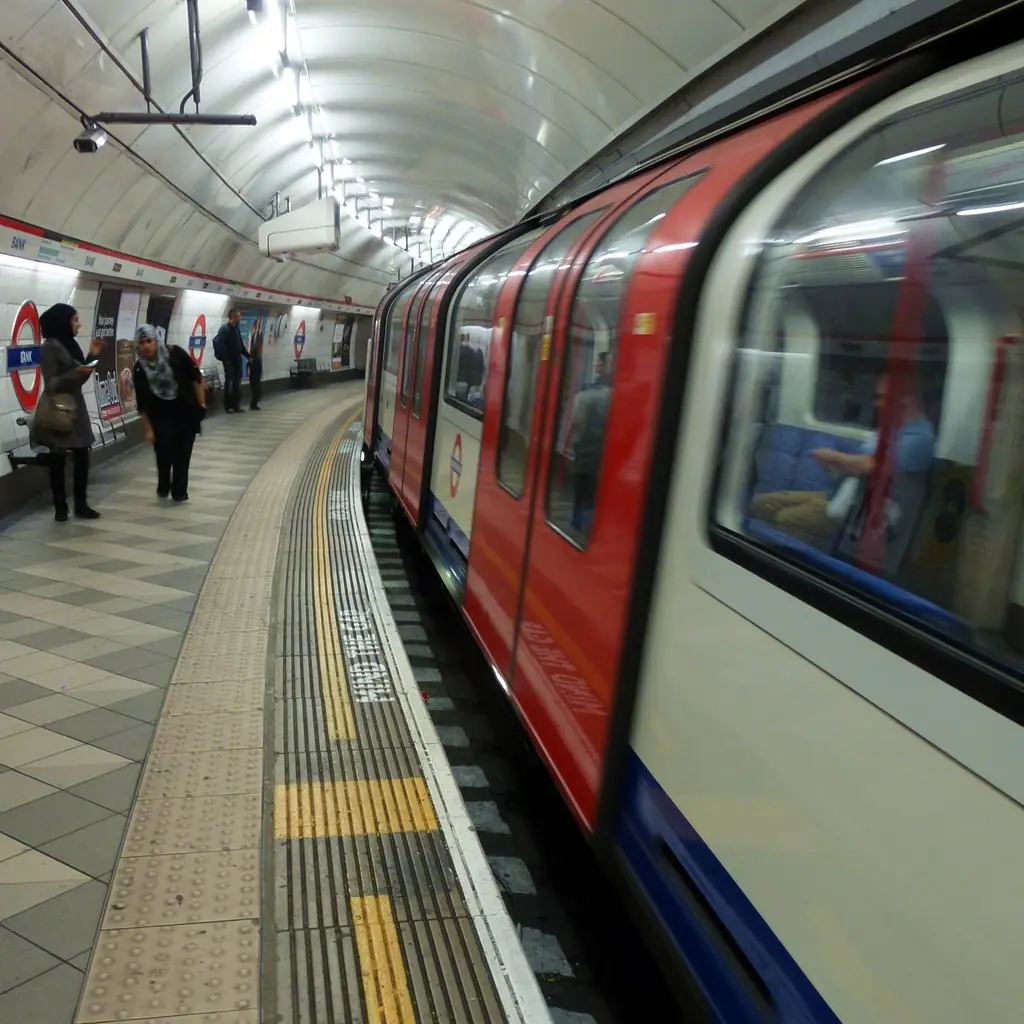
A station platform is fixed; trains move, vary in shape and have doors at particular positions. The two surfaces cannot simply be treated as one continuous floor. At curved platforms, a straight train meets the edge at different distances along its length. Transport for London explicitly identifies large gaps at some curved platforms and supplies station-specific accessibility information. The warning therefore belongs to the geometry of railway infrastructure, not to a quaint local custom. S3
The gap is also vertical. A level route to the platform does not always mean level boarding onto the train. TfL distinguishes the journey to the platform from the transfer into the carriage; ramps, raised platform sections and other measures can help bridge what remains. For one passenger the space is a brief step, for another it determines whether the journey is possible without assistance. The words draw attention to a hazard but cannot remove it. S3

A warning enters London’s vocabulary
Transport for London dates the introduction of “Mind the Gap” to 1968, when London Transport adopted it for passenger safety. The first recording used the voice of sound engineer Peter Lodge. That detail matters because a commonly repeated story names another voice as the origin. Oswald Laurence became associated with a later, much-loved announcement, but he was not the first recording according to TfL’s own history. S1 S2
The phrase succeeds by being short and direct. “Mind” asks for awareness without describing an accident; “the gap” points to something visible underfoot. The message can be printed near a door, spoken over a loudspeaker and understood amid the noise of a station. Its repetition is essential. A warning on a platform must reach people who arrive distracted, in a hurry or in a language environment that is new to them.

The voice is part of the place
It is easy to imagine a single timeless recording playing throughout the Underground. In reality, announcements have different voices and histories across lines and stations. TfL’s account of Bayswater records Peter Lodge’s 1968 recording and notes that other voices have since been used. The identity of the speaker changes, while the safety instruction remains immediately recognisable. S2
The recorded voice does more than transmit information. It gives a repeated moment in a journey a rhythm: approaching train, pause, doors, warning, departure. Commuters hear it hundreds of times and gradually stop consciously hearing it at all. That is the paradox of effective routine signage. Familiarity helps a message become instant, yet it can also reduce the attention given to the very risk the message describes.

Letters laid into the platform
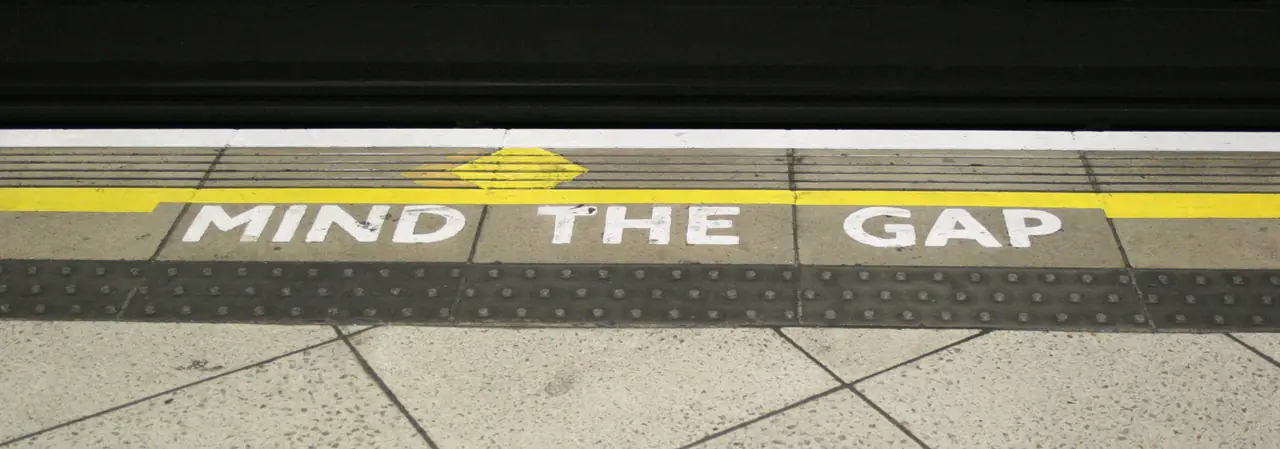
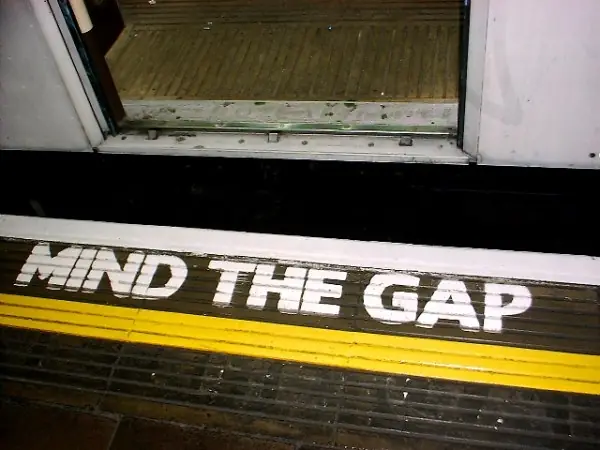
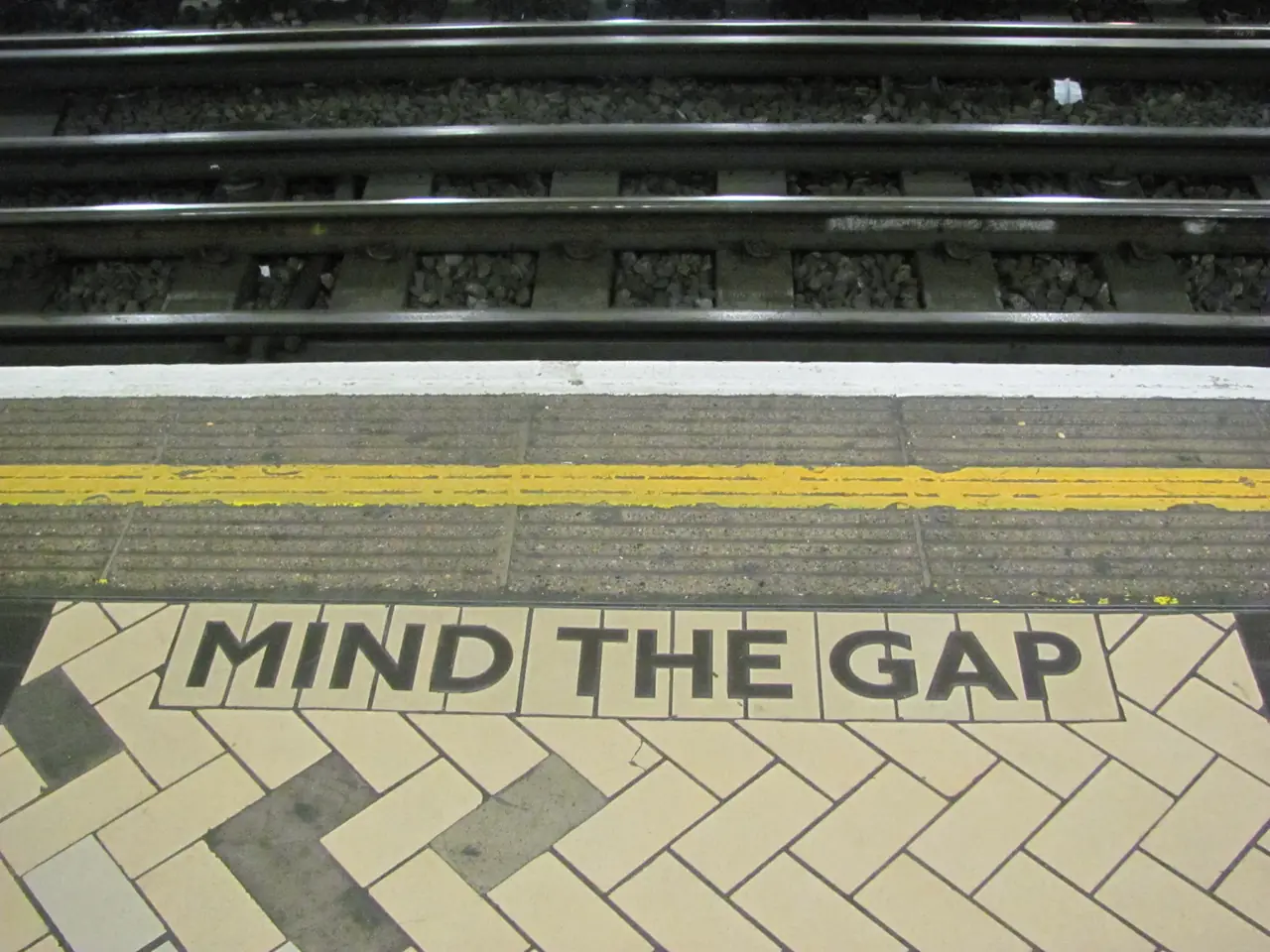
The warning is not limited to sound. It appears in painted letters, strips at the edge and sometimes permanent mosaics set into the platform floor. Each version places the words close to the moment when a passenger must act. The surface of the station becomes a communication medium, and the words are read while feet are moving rather than while someone studies a signboard. S1
That location gives the design its force. From a distance, the platform marking joins the noise of other urban graphics. Up close, just as the doors open, it becomes specific. The line on the floor also marks a boundary between public waiting space and a moving machine. The typography is not merely an emblem of London; it is a piece of operating infrastructure whose scale and placement affect whether people notice it.

From warning to souvenir
Few safety instructions become cultural symbols. “Mind the Gap” now circulates on objects, in images and in memories of London, often detached from any actual platform. TfL describes the phrase alongside the Tube map as a brand asset as well as a vital safety message. Its popularity shows how a repeated public instruction can acquire an identity beyond its original task. S1
There is a tension in that transformation. A souvenir turns the words into a charming shorthand for the city; the real platform asks for attention to a physical discontinuity. Neither meaning cancels the other. London’s transport system is made not just of tunnels, trains and diagrams but of small instructions that passengers learn through use. This one travels because it is brief, rhythmical and attached to a common bodily experience.

The gap remains a design problem
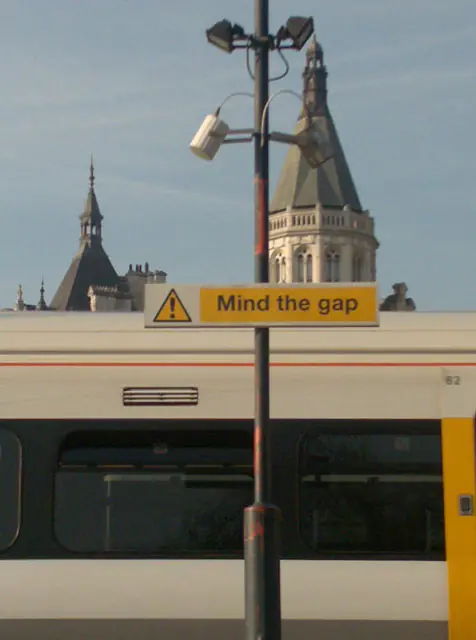
If the warning were enough on its own, platforms would need no physical changes. TfL’s accessibility guidance describes platform humps, level boarding points and ramps, while its current journey planner shows steps and gaps at specific stations. Those measures reveal a broader principle: safety communication and engineering have to work together. A notice can tell passengers to look down, but a smaller gap makes boarding easier in the first place. S3
The problem varies across a network that was built and rebuilt over many decades. A phrase that can be repeated everywhere meets a different physical situation at each platform. It must therefore coexist with local information and staff assistance. At King’s Cross the message in the photograph is a particular marking in a particular place, even as its words have become an international symbol of the Tube.

Seeing the familiar again
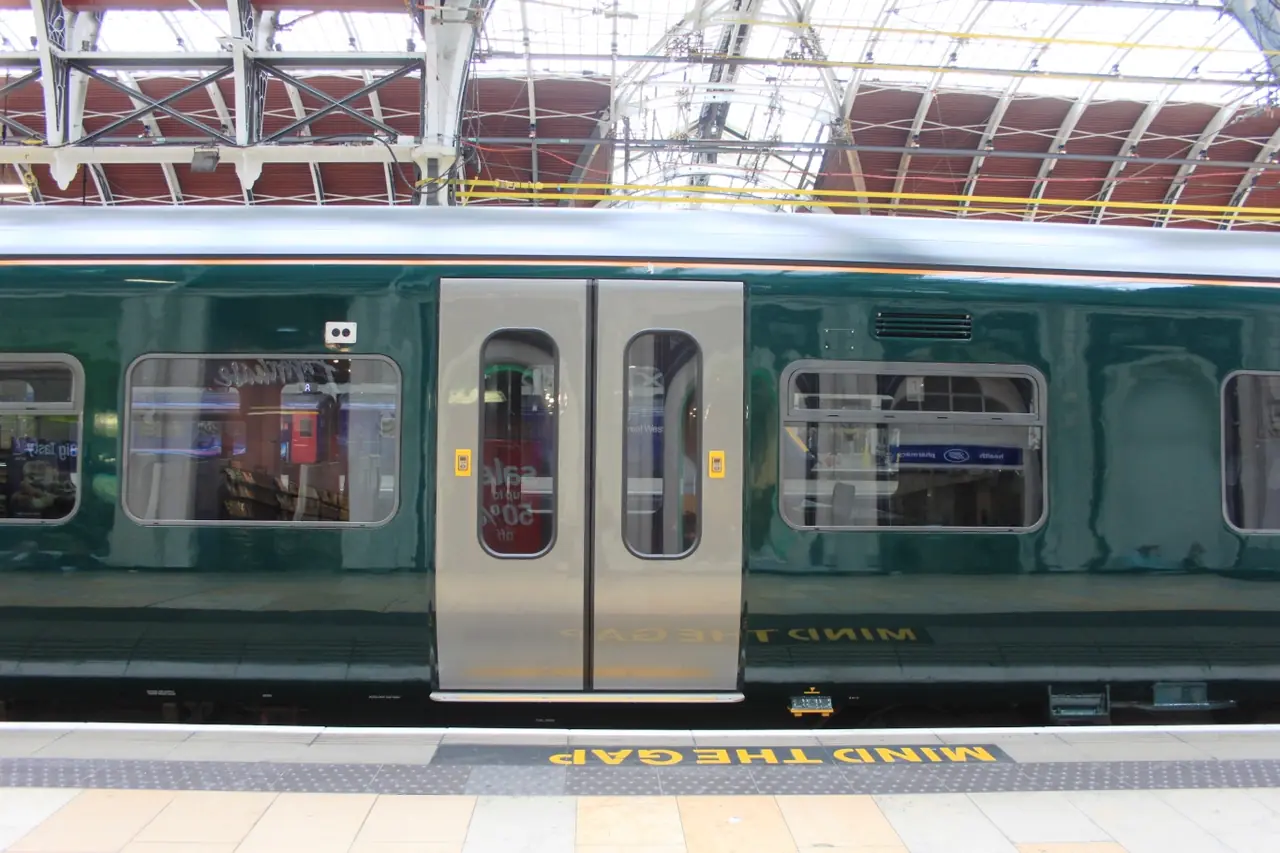
Stand back from the edge and watch a train pull in. Notice where the carriage is closest to the platform and where the space widens. Read the words on the ground as instructions made for moving bodies, not as a slogan designed for a poster. Listen to the voice and remember that it is part of a changing system of recordings, signs and engineering responses.
The phrase endures because it links language to a precise instant of risk. It also offers a compact story about public design: a three-word warning introduced in 1968 becomes daily habit, then a city symbol, while its original practical purpose never disappears. Every boarding is another test of whether the passenger, the message and the platform meet at the right moment. S1 S3
Frequently asked questions
When was “Mind the Gap” introduced?
London Transport introduced the phrase for passenger safety in 1968, according to TfL’s account of its brand history. S1
Who recorded the first announcement?
Why can the gap be wider at some stations?
A straight train alongside a curved platform leaves different distances between carriage and edge. Local designs and train types also matter. S3
Does step-free access mean there is no gap?
No. TfL distinguishes access to the platform from access onto the train, and offers information about ramps and level boarding points. S3
Sources
More in UK